
Celebrating Comms Day remembering the Bit of Clytemnestra
by [fran]A few weeks ago, while preparing a talk about "Justice and Books" for a Readers Club, I was pleasantly surprised to find a comms system having a prominent role in the ancient Greek tragedy written by Aeschylus, the Oresteia trilogy.
The city of Argos is waiting news about the Troyan War. Did Agamemnon succeed?
The play opens with a watchman at the rooftop of the palace looking far off in the distance, waiting for a signal. A fire signal!
So now I am still awatch for the signal-flame, the gleaming fire that is to harbinger news from Troy and tidings of its capture. [...] May the fire with its glad tidings flash through the gloom!
Finally he sees the fire lighten up and he happily descends to the palace to tell the news to Queen Clytemnestra, who then announces to the elders (represented by the chorus): the Argives have taken Priam’s town!, refering to the King of Troy, father of Paris, usurper of Helen, wife of Menelaus, brother of Agamemnon, avenger and King of the argives.
Interestingly, the elders insinuate that the queen may have had visions in her dreams and demand proof. Look at this fragment from an engineering point of view:
Chorus: -But at what time has the city been destroyed?
Clytaemestra: -In the night, I say, that hath but now given birth yonder sun.
Chorus: -And what messenger could reach here with speed like that?
And, luckily for us, she reveals the details of the "firenet" she designed and deployed:
Hephaestus, from Ida speeding forth his brilliant blaze. Beacon passed beacon on to us by courier-flame: Ida, to the Hermaean scaur in Lemnos; to the mighty blaze upon the island succeeded, third, the summit of Athos sacred unto Zeus; and, soaring high aloft so as to arch the main, the flame, travelling joyously onward in its strength . . .the pine-wood torch, its golden-beamed light, as another sun, passing the message on to the watch-towers of Macistus. He, delaying not nor heedlessly overcome by sleep, neglected not his part as messenger. Far over Euripus’ stream came the beacon-light and gave the signal to the sentinels on Messapion. They, kindling a heap of withered heather, lit up their answering blaze and sped the message on. The flame, now gathering strength and in no wise dimmed, like unto a radiant moon overleaped the plain of Asopus to Cithaeron’s scaur, and roused another relay of missive fire. Nor did the warders there disdain the far-flung light, but made a blaze higher than had been bidden them. Across Gorgopus’ water shot the light, reached the mount of Aegiplanctus, and urged the ordinance of fire to make no dallying. Kindling high with unstinted force a mighty beard of flame, they sped it forward that, as it blazed, it o’erpassed even the headland that looks upon the Saronic gulf; until it swooped down when it reached the look-out, nigh unto our city, upon the peak of Arachnaeus; and next upon this roof of the Atreidae it leapt, yon fire not undescended from the Idaean flame. Such are the torch-bearers I have arranged—in succession one to the other completing the course; and victor is he who ran both first and last. This is the warrant and the token I give thee, the message of my lord from Troy to me.
Let's break it down:
- Troy --> Mount Ida
- --> Lemnos Island
- --> Mount Athos
- --> Macistus
- --> Messapion
- --> Cithaeron
- --> Mount Aegiplactus
- --> Mount Arachneaus
- --> Agamemnon's Palace
# Some Geometry (literally)
Argos and Troy are 415 km apart, as the crow flies. This is roughly 1% of the Earth circunsference (~40000 km). The cosine of half that angle multiplied by Earth radius (6380 km) is 6376.6 km. That means the two cities are "separated" by a 3.4 km "wall" of "Earth". Pretty hard to find something so high to set the two fires. Splitting the path in 8 equal parts would lower that requirement to 50 m, but they are not equal. The longest part (between Athos and Makistos) is ~160 km so the wall is 500 m.
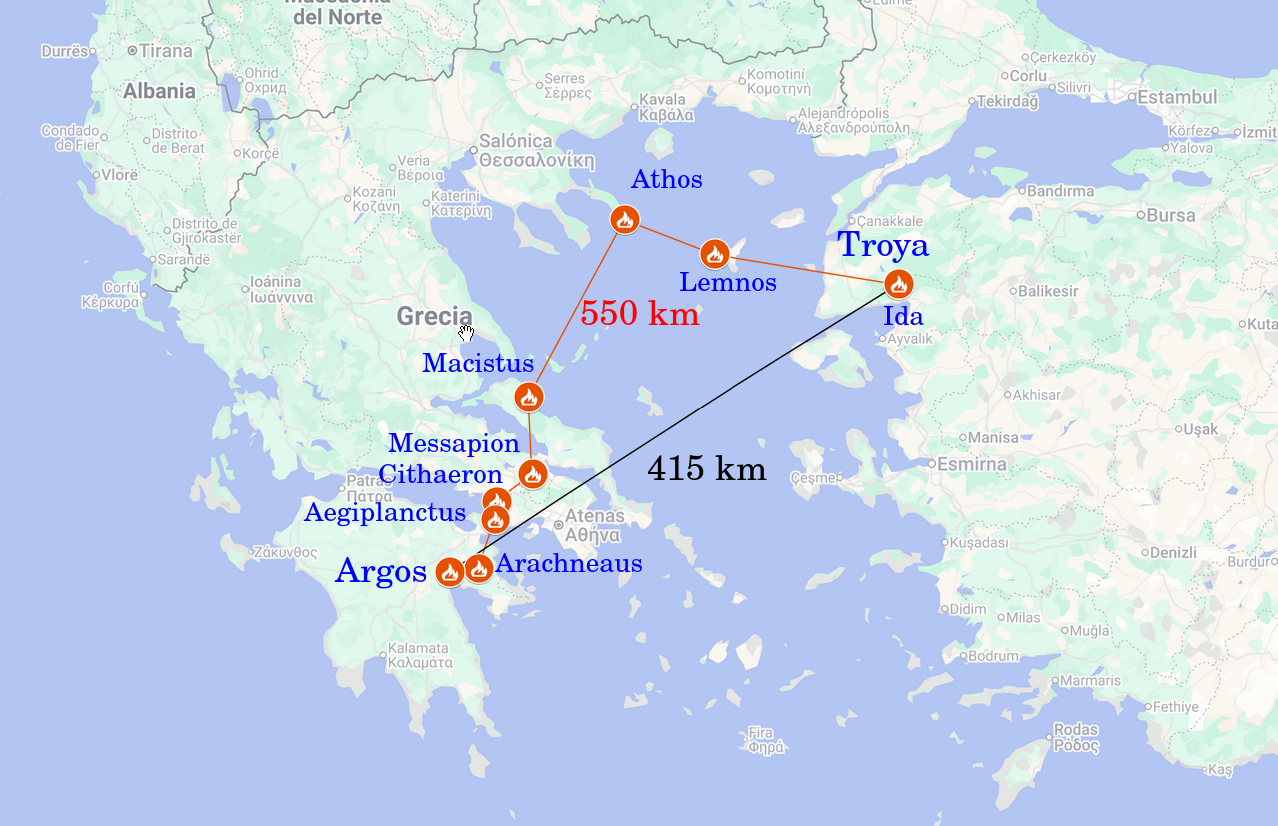
Most modern scholars are not convinced this would be possible, but its not far from feasible. Further reading:
- Message of Fire
- Klytaimestra’s Beacons
- The Victorian Internet, from Tom Standage. Contains no mention to this episode (maybe because its fiction) but it is a wonderful book about the history of our trade.
# Specs
Considering each bonfire takes 30 minutes to reach the required brightness to be seen afar, this system was able to transmit a single bit in 4 hours.
# What if Troy had win?
The system described makes no provision to what to transmit in case of defeat. I won't spoil the pleasure of finding out why.